|
|
The Texas Ten Commandments Law
|
|
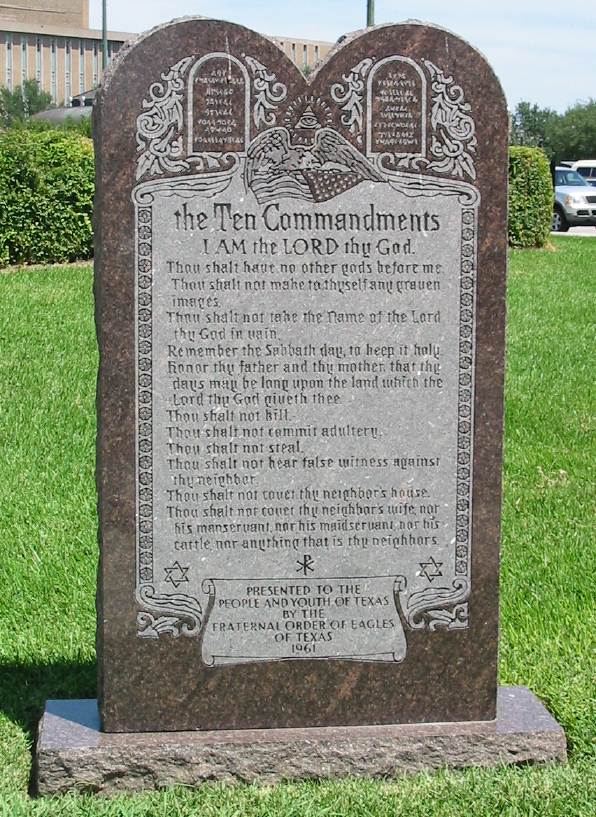
Last month, the state of Texas passed a law, SB-10, requiring the Ten Commandments to be posted in every public elementary and secondary school classroom. According to this law, which takes effect on September 1, 2025, the text of the Ten Commandments must be large enough to be read by “a person with average vision” from anywhere in the classroom in which it is posted. Moreover, the “durable poster or framed copy” must be at least 16 inches wide and 20 inches tall. That’s a large object to put on the wall, though one can imagine a classroom requiring an even bigger one if it is to be seen from everywhere in the room. The Required TextThe Texas legislature specified the exact wording of the Ten Commandments to be displayed and stipulated that no additional material is to be displayed with it. The text is seemingly taken from Exodus 20:2–17 of the King James Version (KJV) of the Bible. Verses 5–6 and 9–11 are omitted—they only elaborate on what are construed as the Second and Fourth Commandments—and there are edits and omissions in verses 2, 4, 7, 12, and 17. In fact, the text is either derived from a Ten Commandments monument on the Capitol grounds in Austin or from an unidentified source common to that monument and to SB-10. The monument (see photo) was given to Texas by the Fraternal Order of Eagles of Texas and was the subject of a 2005 Supreme Court case, Van Orden v. Perry. Remarkably, the court held that the placement of the monument on public property was constitutional. No doubt, legislators felt that if the wording was good enough for the Capitol grounds, it was good enough for public school classrooms. Nevertheless, the very conservative Fifth Circuit Court of Appeals recently declared a similar law passed in Louisiana unconstitutional. Federal lawsuits have been filed challenging the Texas law, and the cases will certainly also reach the Fifth Circuit. Of course, the Supreme Court will likely have the final say on such legislation.
I note in passing that not all “King James Versions” are identical, mostly because spelling and grammar have changed since the original 1611 Bible was published. The SB-10 text largely follows the modern, standard text of the KJV. (This version is meant wherever “KJV” appears below.) Other translations (New International Version, Revised Standard Version, etc.) read differently, and not all religious organizations number the commandments the same way. Neither the monument nor SB-10 numbers the commandments. Peculiarities in the text required by SB-10, that is, deviations from KJV Ten Commandments, argue for the legislature’s having copied the text from the aforementioned monument. What follows is a listing of those peculiarities. Verse 2 is rendered “I AM the LORD thy God.” The KJV verse has a comma after “God” and continues with “which have brought thee out of the land of Egypt, out of the house of bondage.” (All the commandments are reduced to their essentials.) The capitalization of “AM” is odd. The word is usually italicized, indicating that it was inserted by the translators for clarity. If capitalization is being substituted for italics, then the antepenultimate word of the Tenth Commandment, “is,” should be capitalized. It is not. The word “Lord” is rendered in caps in virtually all biblical translations, often with the letters “ord” being set in small caps. Certainly, “LORD” is fine here, but why do the Texas texts use “Lord” in verses 7 and 12, where the KJV uses “LORD”? Verse 4 is truncated. The KJV uses “image,” rather than “images” and “unto thee,” rather than “to thyself.” Verse 7 is truncated. The KJV does not capitalize “name.” Curiously, the 1611 Bible does. Verse 12 has a comma after “mother,” but the KJV has a colon instead. Oddly, verse 17 substitutes “cattle” in place of “ox, nor his ass.” Perhaps this is a Texas thing, or perhaps “ass” was deemed objectionable. What Will Children Think?The Texas law fails to explain why SB-10 is necessary and proper, particularly in light of the prohibitions of the First and Fourteenth Amendments against religious establishment. Leaving that aside for the moment, what are children likely to take away from the required posters? The first four commandments (only one God, no graven images, no taking the Lord’s name in vain, and keeping the Sabbath holy) are strictly religious rules that do not correspond to any state or federal laws. (Blue laws, now largely repealed, attempted to restrict activities on Sundays. Of course, the Sabbath of the Fourth Commandment refers to the Jewish day of rest, Saturday. Such laws were inappropriate in a supposedly free, secular country.) Students may be perplexed by the phrase “graven images” in the Second Commandment. Other biblical translations (the New Revised Standard Version, for example) more helpfully substitute “idol” for “graven image.” In any case, children cannot help but infer that these commandments represent official state religion. This is confusing at best and likely damaging to children who are neither Christian nor Jewish. Of the remaining commandments, four (the Fifth, honoring parents; the Seventh, eschewing adultery; the Ninth, requiring truth telling; and the Tenth, avoiding covetousness) address behaviors that, however socially desirable, are generally legal in a free country. All except coveting can involve legal repercussions in very specific circumstances, such as lying under oath. The posted commandments do not admit of nuance, however. I would like to know how adultery is to be explained to first graders. May we never have to find out! Only the Sixth and Eighth Commandments (don’t kill and don’t steal) are codified in law, and neither is prohibited absolutely, although these actions are unlawful in most circumstances. The prohibition against killing may provoke some lively classroom controversy, since the state (and Texas in particular) executes criminals and sends soldiers abroad to kill enemy combatants. The New Revised Standard Version of the Bible substitutes “murder” for “kill,” a helpful alternative. Following the Israelites’ having received the Ten Commandments, they engaged in a God-sanctioned rampage of killing against the existing inhabitants of the land they were about to occupy. Arguably, this killing was not murder, though students may quibble about this fine point. Rationale for the PostersGiven that only two commandments correspond to U.S. law in any straightforward way, why is religious text being posted in public school classrooms? The Christian Nationalist justification for such displays is that (1) the United States is intended to be a “Christian Nation,” and (2) the Ten Commandments is fundamental to American law. Both assertions are absurd. The American Revolution was not a product of the Protestant Reformation, but of the distinctly secular Enlightenment. Whereas the Continental Congress, in its Declaration of Independence, invoked “Nature’s God,” “their Creator,” “the Supreme Judge of the World,” and “divine Providence,” in its appeal to “the Opinions of Mankind,” its divine references are generic, inserted so as to make its appeal more acceptable to a nominally Christian audience. The Declaration was not made in the name of a deity, Christian or otherwise, but “in the Name, and by Authority of the good People of these Colonies.” The Constitution, intended only for internal governance, makes no mention of God or religion. Only in the First Amendment is religion mentioned. There, the free exercise of religion is guaranteed, but religion is explicitly divorced from actions of the government. The framers were well aware of the mischief religious differences had visited upon Europe and England. Passionate religious conflicts were not unknown in the colonies themselves. The framers wisely chose to keep government out of religious disputes. Our Founding Fathers may have intended to create a godly nation, but they quite intentionally avoided creating a Christian one. Even at its birth, the new Republic was religiously diverse, and promoting one religion over another could only have diminished the fledgling nation’s chance of success. Present-day advocates for a Christian America are either ignorant of our nation’s history or refuse to accept it as a given. In fact, the separation of church and state, a remarkable idea in the eighteenth century, is among the greatest philosophical insights of the founders of the Republic. Although some parents may support posters of the Ten Commandments in classrooms, other parents, even Republican ones, believe that the commandments are part of religious education that belongs in the home or in places of worship. As suggested earlier, only two of the Ten Commandments relate to American law in any direct way—the prohibitions against killing and theft. But the commandments were not the first collection of laws in the ancient world, and prohibitions of killing and theft are common among the world’s religions, legal codes, and philosophical writings. There is no evidence that the Ten Commandments had much influence on the development of American law. What influence the commandments had in the colonies was often malign. (Think of The Scarlet Letter, for example.) From a strictly historical perspective, displaying the commandments in every school classroom is bizarre. It would be more appropriate to display quotations from Locke, Rousseau, Jefferson, Franklin, Paine, or even the Declaration of Independence. Unfortunately, there are those in this country who would destroy public schools in favor of the government’s financing private, mostly Christian, ones. It is unclear how many citizens embrace this goal. It is likely a small minority, financed by wealthy people with their own priorities. Like the separation of church and state, the idea of public schools for all is one of the great ideas of the Republic. Those who would destroy our system of public education see inserting Christianity into the public schools as either an acceptable fallback position or a stepping stone toward their ultimate goal. These misguided people must be stopped. Final ThoughtsThe Texas legislature is becoming notorious for its far-right decisions. This seems unlikely to change anytime soon. SB-10 is hardly an outlier. It is divisive, will harm public education and its students, and it expends resources needlessly on posters and litigation. Education in Texas has more pressing needs than Ten Commandments posters. Challenges to SB-10 will likely be successful at the Fifth Circuit in light of that court’s recent Louisiana decision, but the fate of an appeal to the Supreme Court cannot be predicted. In light of court decisions that have gradually undermined the wall between church and state, the justices may well approve Ten Commandments in Texas classrooms. In that case, such posters may show up in other states as well. — LED, 7/7/2025 |


|
|