Another Family of Designs
On an earlier page, I described placing
parabolas within regular polygons as offering infinite possibilities. I
decided to explore a few of those infinite possibilities. In particular,
I restricted designs to those drawn within regular polygons. The
following characteristics can be manipulated:
- Background color
- Line color
- Number of sides of the polygon
- Number of segments into which each side is
divided
- Whether parabolas drawn are
standard or
alternative
- Which pairs of polygon sides provide axes for
parabolas
- Whether the polygon itself is drawn
Item (6) requires some explanation. Rather drawing
lines using the notion of offset defined earlier, I
chose to construct parabolas using as axes sides of the polygon that are not
necessarily adjacent.
I first got interested in these constructions after
producing the design below. (This and the following images may be reduced or
increased in size without loss of fidelity.)

This nonagon (9-sided polygon) has each side divided
into 25 segments. The parabolas are drawn using the alternate construction with
axes separated by 1 side. Thus, if we were to number the sides of the nonagon in
a counterclockwise fashion, sides 1 and 3, 2 and 4, etc., would be used as axes
of parabolas. We can call the separation in this sense s, where normal
parabolas would be drawn when s = 0.
This figure below is identical, except that the standard
construction is used for the parabolas. The difference between these figures is
subtle. Notice which lines connect to the
nonagon vertices in the two figures.

In the next figure, the surrounding polygon is a
dodecagon, a 12-sided figure. The dodecagon is not drawn, however. Its sides are
divided into 15 segments, and s is 4. Parabolas are drawn using the
standard construction, which creates the “rays” that seem to emanate from the
center of the figure.

The diameter of the empty area in the center of one of
these figures depends on the value of s. In the figure below, that “hole”
has disappeared. The enclosing figure is an octagon whose sides are divided into
30 segments, and s is 3. Again, the parabolas—they are really not
parabolas at all, of course—are standard.

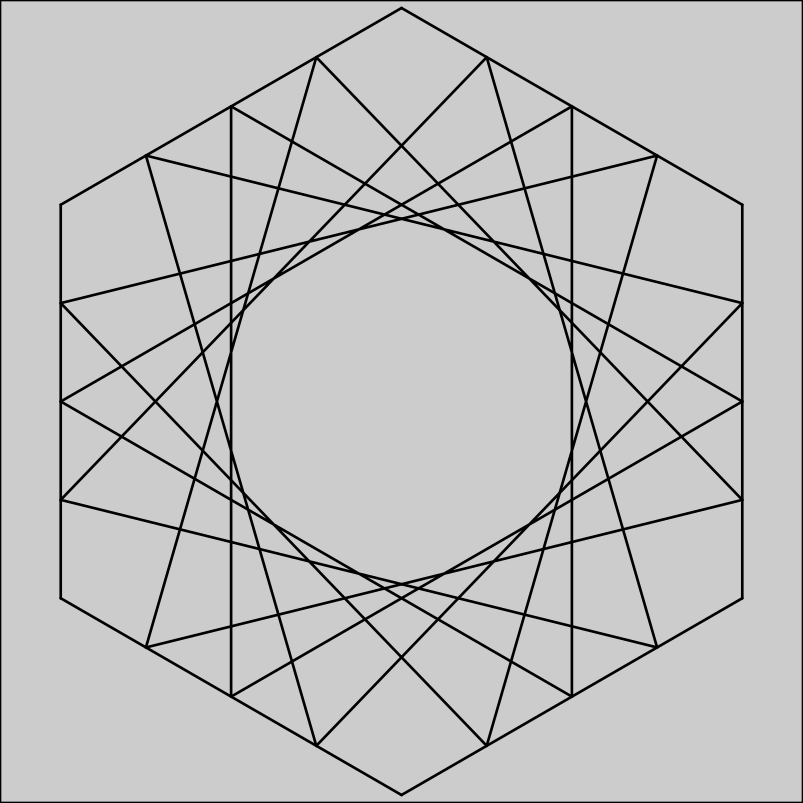
Below, I show two figures to clarify how the previous
figures are constructed. The polygon is a hexagon, s is 1, and sides are
divided into 4 segments. In the first figure, the alternative form of parabolas
is used; in the second, the standard form is employed.

Finally, I offer a figure
of embedded decagons. Each polygon has an s of 1, has sides divided into
15 segments, and uses parabolas drawn in the standard fashion. To keep the
figure as clear as possible, the width of the lines used for the inner decagons
is less than that of outer figures. Enlarge the figure to appreciate the fine
detail.

— LED, 3/7/2024 rev. 3/9/2024 |



