|
These haiku were inspired by e-mail from a friend
returning from a business trip to New Orleans, where I grew up. He complained about the torrential rain that greeted his arrival. The message I
wrote in reply contained a sentence with haiku-like meter, which I
transmogrified into “New Orleans.”
Eventually, I wrote poems for all the places I’ve
lived for any length of time. I attended college in Chicago and,
for a long time, lived in Mt. Lebanon, a suburb of Pittsburgh. For a brief time, I taught at Allegheny College in
Meadville, in northwest Pennsylvania. I also taught in Raleigh at North Carolina
State University. I served in Army bands in both Atlanta and Honolulu. I also
attended graduate school in Atlanta. I currently live in Indiana, Pennsylvania.
Most of these poems were written between 2001 and 2005. “Indiana, Pa.” was
written in 2018.
I don’t know how much of the content of these
poems I need to explain, but I’ll offer some brief notes. New Orleans, of
course, is built on a swamp, roughly at sea level. In its early history, yellow
fever was common. Mosquitoes and rain are still prominent features of life in
the Crescent City. My judgment on the location of New Orleans seems prescient in
light of the devastation caused by Hurricane Katrina in 2005.
Chicago is nearly as flat as New Orleans, but the
ground is more stable. From the air, the grid of streets spreads out from the
lakefront as far as the eye can see. That grid is crisscrossed by expressways
that, at rush hour, might be mistaken for parking lots.
Pittsburgh was once the steel-making (and air pollution)
capital of the U.S. The steel mills are gone from the city now, which allows the
natural beauty of the landscape to be seen.
Bridges of Pittsburgh, by Bob Regan, with photos by Tim Fabian,
claims that Pittsburgh has 446 bridges. My haiku appears in this book as an
example of art inspired by Pittsburgh’s bridges.
Meadville residents will understand “Meadville,
Pa.,” but no one else will without an explanation. The place was founded over 200
years ago by David Mead, after whom it is named. Meadville is a town of about
13,000 people with a long, and mostly happy, industrial history. The
’80s were unkind to Meadville, however, as the Avtex Fibers and Talon
Zipper plants closed, leaving
Channellock, a maker of pliers, as the best-known
manufacturer in town.
I lived nearly all of 1970 and 1971 in Honolulu,
courtesy of the U.S. Army. Hawaii was culturally interesting, architecturally impoverished,
and climatically pleasant. It did come as something of a surprise, however, that
the perpetual sunshine and year-round average temperature of 75°F could, in
its way, become oppressive after a time. No doubt, the phenomenon is intensified
by one’s being isolated on a small island in a vast ocean. “Island fever”
is endemic among extend-stay mainlanders.
I spent time in Atlanta at Georgia Tech and at the
U.S. Army’s Ft. McPherson in the late ’60s and early ’70s. Southern charm
was in short supply even then, but the place had many attractions for young
adults. The city, unconstrained by the usual natural barriers, was rapidly
becoming the expanse of urban sprawl that it is today. Do I have to tell anyone
that Margaret Mitchell wrote Gone with the Wind?
Raleigh, North Carolina, is one of the cities forming the
Research Triangle, the others being Durham and Chapel Hill. Within the triangle
formed by these three cities is the high-tech Research Triangle Park. The three
cities are well-known for their respective universities—North Carolina State,
Duke, and University of North Carolina, often referred to simply as “Chapel
Hill.”
Indiana, Pennsylvania, is the town in which Jimmy
Stewart grew up and where his father ran a hardware store. The town is proud of
the Stewart connection. It stages an It’s a Wonderful Life Festival every year
and sports a Jimmy Steward Museum. (Steward starred in the movie It’s a
Wonderful Life, reputedly the star’s favorite role. The Frank Capra film’s
Bedford Falls, however, was supposedly based upon Seneca Falls, New York, which
has its own It’s a Wonderful Life Museum and festival.) Indiana also claims to be the
Christmas Tree Capital of the World. (The national Christmas Tree Grower’s
Association was founded in Indiana, and many Christmas trees are grown in the
area.)
Clifton Springs, N.Y., is a Finger Lakes village
named for mineral springs in the area. Although it was settled about 1801 and
was once called Sulphur Springs, it only became well-known due to the efforts of
Dr. Henry Foster. He arrived in 1849 after having searched for a location at
which he could offer his water cure. Dr. Foster attracted thousands to the area to
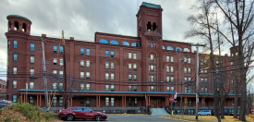
partake of his therapy. In 1896, he built a sanitarium that is now the Spa
Apartments. What became the American Occupational Therapy Association was also
born in Clifton Springs.
— LED 10/4/2005, rev.
4/6/2023
|